
Is Anker good? The short answer
For most people, yes. Anker is one of the most widely sold charging brands in North America, and its power banks, wall chargers, and cables are a sensible default when you want something more reliable than a no-name accessory. The brand covers the basics well: clear wattage labels, USB-C Power Delivery on most current chargers, and a broad range of sizes from pocket chargers to laptop-class power banks.
That does not mean every Anker product suits every buyer. The right choice still depends on what you charge, how fast you need it, and where you carry it. This guide explains how to read Anker listings, which numbers matter, and the checks worth doing before you order. Good Sense may earn a commission if you buy through the Anker Canada links on this page; that does not change the checklist.
Who Anker is and what it sells
Anker Innovations started in 2011 with replacement laptop batteries and grew into a broad consumer electronics company. Charging is still the core: power banks, wall chargers, multi-port desktop chargers, cables, docks, and magnetic MagGo chargers for iPhone. The company also runs sister brands, including Soundcore for audio, eufy for smart home devices, and Anker SOLIX for portable power stations.
For a shopper, the useful takeaway is that Anker sells several product tiers. Entry models focus on price, Nano chargers focus on small size, and Prime models aim at higher wattage and multi-device charging. Comparing within the right tier is more useful than comparing the brand as a whole.
How to choose an Anker power bank
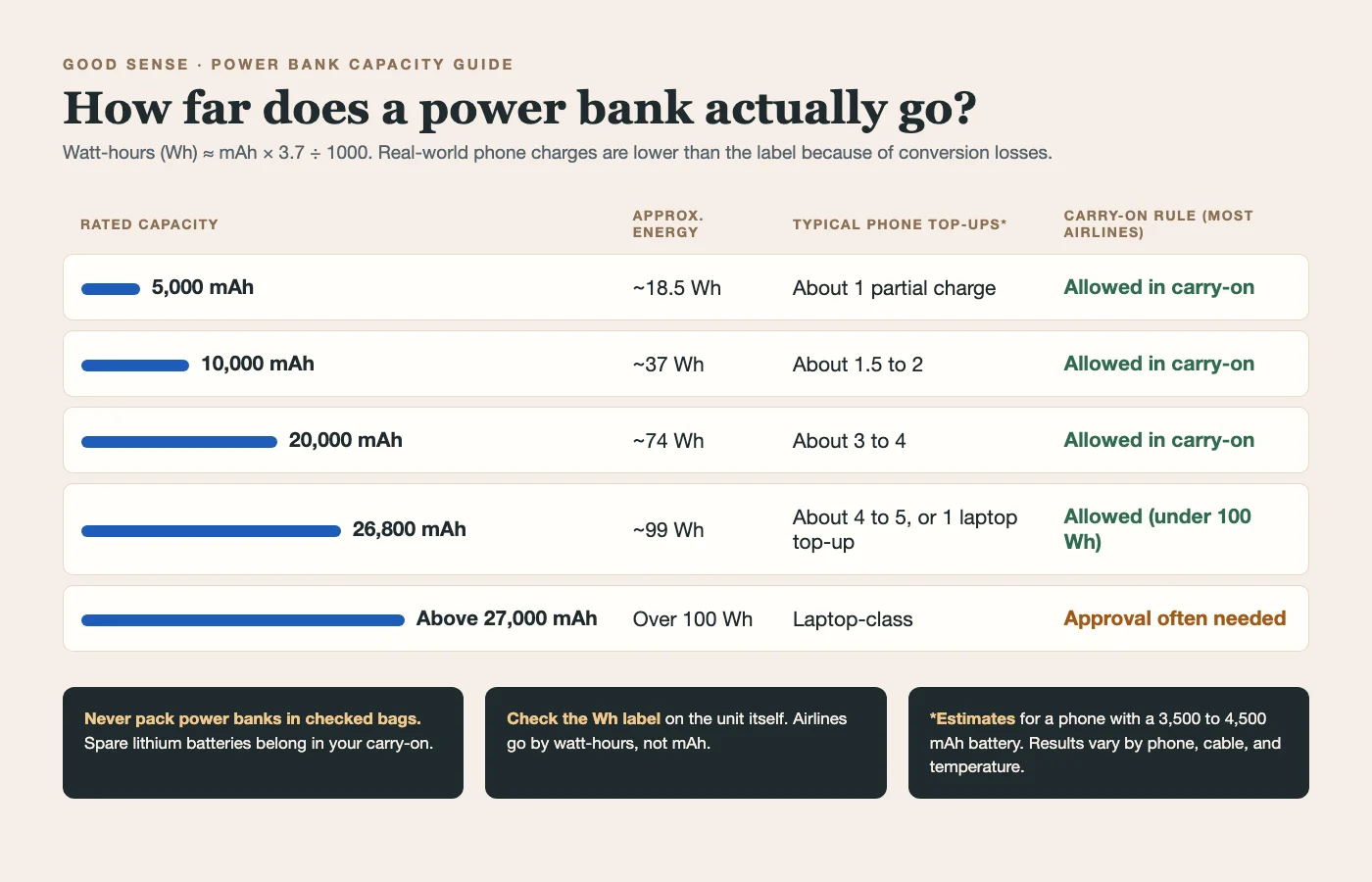
Start with capacity. A 5,000 mAh pack suits a short day out, 10,000 mAh covers roughly one to two phone charges, and 20,000 mAh or more suits travel or charging a tablet. Bigger packs are heavier, so think about whether it lives in a bag or a pocket.
Next, check output. If you want to charge a laptop, look for USB-C Power Delivery at 45 W or higher and confirm your laptop accepts USB-C charging. For phones, 20 to 30 W is usually plenty. Also look at how the pack itself recharges: a higher input wattage means less time plugged into the wall.
Finally, consider form factor. Magnetic packs are convenient for iPhone users but trade some efficiency for convenience, while packs with a built-in cable reduce clutter but are harder to repair if the cable wears out.
Wall chargers: wattage and GaN explained
Many current Anker wall chargers use gallium nitride (GaN) components, which allow more power in a smaller body. The number that matters is total wattage and how it is shared across ports. A 65 W charger with two ports may give 65 W to one device but split the power when two are connected.
Match the charger to your most demanding device. Phones usually charge at 20 to 30 W, tablets at 30 to 45 W, small laptops at 45 to 65 W, and larger laptops at 65 to 100 W or more. If you plan to charge a laptop and a phone at once, choose a charger whose shared output still covers the laptop.
Cables matter more than they look
A fast charger is limited by its cable. For USB-C laptops, look for a cable rated for the wattage you need, often 60 W or 100 W, and some high-power setups need 240 W cables. Braided cables usually resist fraying better, but the rating printed on the listing is the specification to compare.
Replace cables that are frayed, bent sharply near the connector, or that get warm in normal use. A damaged cable can slow charging or become a safety issue.
Travelling with a power bank
Airlines judge spare batteries by watt-hours (Wh), not milliamp-hours. Power banks under 100 Wh are generally allowed in carry-on baggage without airline approval, which covers most packs up to about 26,800 mAh. Packs between 100 and 160 Wh often need airline approval, and spare lithium batteries should never go in checked luggage.
Look for the Wh figure printed on the power bank itself, since security staff may ask to see it. Rules can differ by airline and country, so check the CATSA guidance and your airline before you fly.
Warranty, support, and recalls
Anker products usually come with a limited warranty, commonly 18 months or more depending on the product line. Check the exact term on the product page, keep your order confirmation, and register the product if the site offers it.
Like other large battery brands, Anker has recalled some power bank models. In June 2025 it announced recalls of several models, including a PowerCore 10000 power bank. If you own an older pack, compare the model number printed on the device with the notices on the Anker recall page and the Health Canada recall database, and stop using an affected unit.
How Anker compares with other charging brands
Anker competes with brands such as Belkin, UGREEN, Baseus, and the chargers sold by phone makers themselves. Across these brands, the basic technology is similar: USB-C Power Delivery, GaN chargers, and lithium-ion power banks. The differences tend to come down to product range, port layouts, build quality, warranty handling, and how easy it is to find support in your country.
Anker stands out for breadth. It usually has a model at each common capacity and wattage, which makes it easy to match a product to a specific need, and its Canadian store keeps warranty and returns local. If a competitor offers the exact port mix or size you need at a better price, it can be just as reasonable a choice. Compare the specifications first and let the brand break a tie.
Buying from Anker Canada
Buying from the official Canadian store makes warranty claims and returns simpler, and prices are shown in Canadian dollars. Compare the total cost with shipping and any bundle pricing, and read the return window before ordering. Retailers sometimes run different promotions, so a quick price check is worthwhile.
Before you order, confirm the exact model number, the output for each port, the included cable type, and whether a wall adapter is included. Many power banks ship without one.
Anker FAQ: common questions from buyers
Is Anker a good brand for power banks? For everyday use, yes. Its power banks are widely available, clearly labelled, and supported by a warranty. As with any battery product, buy from an authorized seller and check the model against recall notices.
Is an Anker charger safe for my iPhone or Android phone? Modern phones negotiate charging speed with the charger, so a higher-wattage USB-C charger will not force too much power into a phone. Use a cable rated for the charger and avoid damaged cables.
How long does an Anker power bank last? Lithium-ion cells gradually lose capacity with charge cycles, heat, and age. Storing the pack at room temperature, avoiding leaving it in a hot car, and not keeping it at 0 percent for long periods all help it last longer.
Can an Anker power bank charge a laptop? Some can. Look for USB-C Power Delivery output of at least 45 W for small laptops and 65 W or more for larger ones, plus enough capacity, usually 20,000 mAh or higher, for a meaningful top-up.
Final checklist before you buy
Choose capacity for your day: 10,000 mAh for daily carry, 20,000 mAh or more for travel and tablets. Match wattage to your most demanding device, and make sure the cable is rated for it. Check the Wh label if you fly, register the product for warranty, and confirm the model is not on a recall list.
Handled that way, Anker is a dependable choice for everyday charging. The brand name helps, but the specifications that fit your devices are what make a charger or power bank worth buying.